The gold covered Dome of the Rock dominates the skyline of Jerusalem. Today, only Muslim worshippers are allowed within the shrine itself, but at selected times tourists are allowed onto the great platform, called the Temple Mount or
Al Haram es-Sharif (Click on the words for a virtual tour). From the ramp walkway, we could look out over the Western Wall.
The Dome of the Rock covers the peak of Mount Moriah, where Abraham offered up his beloved son. This story and this site are revered by Jews, Christians, and Muslims. Here sat the Temples of Solomon, Zerubbabel, and Herod. We passed many Muslims praying, fountains for ritual washing, graceful arched entryways, tall trees and artistic geometric designs.
Following the commandment to not worship graven images, this shrine is decorated with passages from the Quran in Arabic calligraphy.
This is a look at the back entrance to the Golden Gates, which is permanently sealed. You can get an idea of how large these gates are.
Our visit to the southeastern desert began at
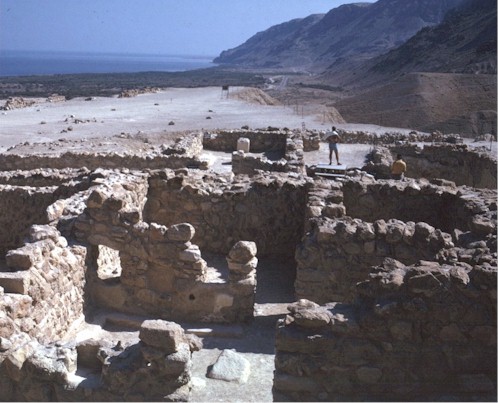
Qumran on the western shores of the Dead Sea. You've probably heard about how the Dead Sea Scrolls were accidently found when a goatherd threw a rock into a cave and heard a jar break. The caves yielded a rich treasure of texts and spurred greater interest in the Essenes who lived at Qumran. This group of Jewish separatists aimed for ritual purity and harmonious community life.
Among the ruins can be found a large dining hall, a scriptorium, and several mikvot, or ritual baths for immersion. These stairs led down to a font of water, and although the right side of the stairway has deteriorated, you can see a raised divider that would have symbolically separated those who were descending in a ritually impure state from those ascending in a pure state.
Off to the left of Carrie you can see the famous Cave 4.
Transcription of Biblical texts was an important activity here, and as the political situation heated up, scrolls were hidden in caves to safeguard them, probably with the intention to return and retrieve them later. One of the caves was used as a repository for worn or damaged scrolls; if the name of God appeared in the text, it would have been disrespectful to just discard it like an ordinary piece of parchment.
Qumran seemed to be a place of spiritual refuge, not military refuge. When the Romans came along, not even the remote, hilly location and water storage could protect Qumran.
Masada, on the other hand, was the paragon of fortresses.
To a rugged, inaccessible mountaintop (we rode a cable car), Herod added walls, palaces, barrel vaulted storage rooms, and Roman-style bath houses. He channeled the mountain run-off to flow into deep cisterns, from which water would be carried up by donkeys.
After its construction, Jewish Zealots took over Masada and turned the Roman-style fortification against the Romans. During the Zealot's occupation, a synagogue and mikvot were added.
We walked down to Herod's three-tiered palace with its amazing view of the valley. Remnants of the columns and painted stucco hints at the grandeur of these rooms. The rock here is quite crumbly, and modern reinforcements help protect the stairways and cliffs from erosion.
Carrie liked these little black birds that hung around in the lower palace.
Through a glass window we could see a scribe copying the Torah according to the ancient traditions.
Megan poses under a smiley jet trail.
The black line behind us destinguishes between original walls and reconstructed walls.
The bathhouse floor reflects common designs from Herod' time.
Views from the cable car as we descended from the top of the bottom of the world. The base of the mountain is about 1000 feet below sea level, and the top of Masada is 30 feet above sea level.
Our next stop was a canyon extending west from the Dead Sea coastline (1388 ft below sea level) into the cliffs that supported the Judean Hill Country (655 feet above sea level). Shade, waterfalls, and wildlife make this site memorable. Ein Gedi means the spring of the kid, (the goat kind) but we saw herds of ibex instead.
The trail was steep and uneven, but we made it to the waterfall by holding on the the rod of iron.
Actually the rod was stainless steel, but we were assured that steel is mostly iron.
To the north, the cliff was dotted with caves, and here David spared the life of King Saul as related in
1 Sam 24:-12. South of Ein Gedi is Wadi Arugot, which forms another passageway between Jerusalem and the Dead Sea. Some think that Wadi Arugot is a possible route for Lehi's family.
Our final stop of the day was a dip in the
Dead Sea itself. The water level has been dropping for years as the Jordan River has been harnessed for agriculture upstream.
The southern portion of the sea consists of shallow evaporation basins where minerals are harvested (see the parallel lines in the photo above).
The high mineral content (about 30% salt) means that any open cuts will sting, and bathers are warned to keep the water out of eyes and mouth. We got used to the smell, but the taste of even the tiniest drop of water on our lips was very bitter.
My mom braved the chilly water first. It looks like she is sitting on the rocks, but actually she is floating above them. Rocks on the sea floor are cemented together with a layer of white minerals.
Three generations in the Dead Sea: Carrie, Jill, and Grandma Ann Fillmore. This was fun once we got used to the cool temperature. After our Dead Sea experience, we drove home to prepare for Christmas Eve.
An unexpected opportunity opened for us to go to Bethlehem for the Christmas Eve parade and dinner at Odeh Marcous's house. We were thrilled for this opportunity and grateful to the Jerusalem Center administration and branch members who made this possible.
At Manger Square, we explored the shops, and one craftsman showed us how the olivewood ornaments were made.
This Christmas tree was spouting tiny foam pellets which fell into the green basket and circulated up again.
Emily made a new friend, a Muslim woman who was enjoying the parade with her children. The whole town of Bethlehem seemed to be in Manger square, with head scarves outnumbering Santa hats.
We weren't sure where to stand to have the best vantage point on the parade, but some Muhlestein kids were welcomed on top of a cameraman's van.
Frank Sr. and Lisa were interviewed by Fox News and asked how they felt celebrating Christmas in Bethlehem. Lisa said Christmas feels more real here because this is where Jesus lived. Frank Sr., Lisa, and Amanda showed up on international television.
The children were given free roses, and locals were friendly.
We caught a glimpse of the Church of the Nativity, but with the throngs of people there, it wasn't an ideal time to venture inside. We were glad the grandparents could see it a few days before.
We didn't have a great view of the parade, but we enjoyed hearing the Christmas carols played by marching bands and bagpipe bands. We even saw marching boy scouts. (Boy scouts from our branch had an overnight last semester with a Palestinian boy scout troop.)
This photo is from a branch member who was on the other side of the parade. If you look at the top left of the photo, you can see the Muhlesteins up on the van.
After the parade, we connected with other branch members and had a fun-filled taxi ride to the other side of town near the checkpoint.
We went to Adam Souvenir, where branch member Odeh Marcous sells olivewood souvenirs not far from his home. He was very kind and generous with us and patient with our kids' curious exploration of all the trinkets.
Odeh's wife Sena supports him in hosting LDS meetings in their home and cooked an amazing meal for us of rice, chicken, carrots, potatoes, and onions, with traditional Arab side dishes.
Mohammed Al-Shabbat is the head of the other family in Bethlehem. His wife Rakhme is Muslim, and their three children are very sweet.
Odeh Marcous and Sahar Qumsiyeh, our Relief Society President made sure everyone received a gift that night, including stockings for the children.
We left with a great sense of love for these good families who gave so much of themselves for our benefit.
We had an expanded cast for our traditional Christmas Eve pageant.
Carrie looks so angelic!
We even had a Samuel the Lamanite (Kaleb Muhlestein) who dodged paper wads. I told Dr. John Jackson that we were going to throw rocks at Samuel, but promised none of them would hit him. Dr. John said, "Good, because I'm ready for bed and I wouldn't want to have to come and stitch him up."
Christmas Morning was the Sabbath, and we opened our stockings before church, but the rest of the presents had to wait until after. There just wasn't time before, and we wanted to savor the gifts, not just tear them open. We skyped with family members for most of the evening.
With time running out for the Grandparents' visit, we went to the Western Wall.
I was intrigued by the pioneer bonnet of this woman named Rose from Hong Kong. It was a gift from a friend, and she likes the way it protects her from the sun. Why didn't I think of bringing my bonnet?
We toured the Davidson Archeological Park which curves around the south west corner of the Temple Mount.
This mural depicts a Roman commercial street, or Cardo, which once came through this way.
Overlooking the southwest corner of the temple mount. While the temple was completely obliterated with not one stone standing upon another, the temple mount retainining wall still has a base of Herodian stones.
The Romans smashed or toppled as many stones as they could from the top of the wall. One stone caused the hollow sewer tunnel to collapse on the right side of the picture above. We had recently heard about the fire in the Provo Tabernacle, and we felt shocked and upset. I can't imagine how discouraged and heartbroken the Jews must have been after the destruction of Herod's Temple.
This stone had been overthrown from the pinnacle of the temple, and an inscription (to the left of Frank's mom) connects it with the place of trumpeting. Today in some Jewish areas of the city, I am told, a siren warns the faithful that the Sabbath will begin in a half an hour. Perhaps in ancient times the Shofar or ram's horn trumpet did the same thing from the pinnacle of the temple.
Just one of the massive stones at the base of the Temple Mount.
These soldiers are patrolling the walls for fun, but the arrow slits in those ramparts indicate that these walls were once a functioning defense system.
Later additions to the south of the Temple Mount reused stones from other buildings.
The Hulda Gate accomodated the multitudes of people offering sacrifices at the time of the Savior. On the right at the top of a wide stairway was a triple gate for entrance. Here on the left was the exit, a double gate, mostly hidden today. Both gates connected to the temple mount platform via a tunnel.
Jesus very likely would have walked on this stone step when he visited the temple.
I usually don't go out of my way to photograph the Orthodox Jews in their traditional dress, but this time I was taking a picture of the Dung Gate in the background, and they just walked on by.

Minutes later, this dignified Palestinian woman walked through my photo of Silwan, the village in the background. The overcoat looked comfortable on this chilly day, but we have seen them worn all through the summer as well. A brand new student once asked me if Muslim women as treated as less important than men. I may not be qualified to answer, but I venture my hypothesis that in some ways, a Muslim woman is seen as a treasure to be protected, both by layers of tradition and also by layers of clothing. A woman who is covered in this way may convey the message that she is watched over by a husband, father, uncles, brothers, etc., who care about how she looks, and they would all get involved if that woman was harassed. On the other hand, a woman who wears immodest clothing may send the message that nobody is looking out for her and protecting her. Of course things change as new generations set traditions aside, but we still see hundreds of young Muslim women wearing head scarves in the old city and throughout town.

I didn't take any photos during Hezekiah's tunnel, but it was fun and quite cool, and we emerged into the sunlight at the
pool of Siloam. This is a very nice place to talk about spiritual sight and miracles.
For what we thought would be our last day with grandparents, we went south west of Jerusalem to the Shephelah low hills area. Here we are at Beit Shemesh, with Samson's home town of Zorah off to our right and his first wife's home town of Timnath off to our left (
Judges 14).
Azekah is the hilltop lookout where Joshua conquered the five kings of the Amorites
(Joshua 10:10) and where the Phillistines camped when they sent Goliath forth
(1 Sam 17).
In the Valley of Elah we slung (slang?) some stones. Or at least pretended to for the photo op.
Carrie looks worried. Is Amanda's sling loaded? The fields had been freshly plowed, and we walked past rows of squash plants. I hadn't imagined the growing season would go all the way through December. Somehow we're still getting delicious strawberries in January when there were none to be found in August.
Tel Maresha is one of our favorite places, but this time the place was claimed by a photographer and a bunch of fashion models. On the bright side, we didn't get as much of the chalky limestone all over our clothes this time.
Speaking of chalky limestone, the
Bell Caves at Beit Guvrin are another fun site. The curving walls magnified our voices as the kids ran around like little goats.
Frank's dad climbed up on a big rock near where all the bats live. The area behind him is off limits, probably because that big rock used to be a part of the ceiling.
At another location within Bet Guvrin, the grandparents listen attentively as Frank explains the olivepress.
After this fun day, we went home and prepared to send grandparents to the airport. But while checking online, they discovered their flights were rescheduled for New Year's Eve, three days later. This was a big shock at first because they all had responsibilities back home that were waiting for them, but when it became clear nothing could be done to change the situation, we all were cheered by the thought of three more days together.
On the first bonus day, the grandparents took a taxi to the Holocaust Museum. The next day, Frank took them to David's Citadel Museum.
.
Later that day, we visited the kid's school en route to the Mahane Yehuda shuk and the pita factory
Then on our very last day, we went to the
Herodian. The weather didn't cooperate, but it's hard to complain about a little rain when we live on the edge of a desert during a seven-year drought.
We were so glad to have extra time together!
We felt so blessed to have both sets of parentshere for Christmas. Frank took them to the airport late New Year's Eve, and our wonderful visit came to an end. There were detours on the way home, especially in the luggage department, but everyone was safe and sound.