Thursday, June 30, 2011

Jordan day one


OUR JORDAN TRIP--

Me (carrie) and Dad went to Jordan from Monday to Thursday. It was so fun!!!!!!
since the blog thing doesn't let me put in a lot of pictures at a time, I will explain Jordan in days


DAY ONE


1. Mount Nebo
~sorry no pics at this time~
Please come back at the sound of the beep


2. Madaba:
At Madaba there is a big mosaic map.

This is me next to the sign displaying the mosaic map
This is me by the real thing


Inside the Madaba church, there are other mosaics besides the map:

Mary and Jesus

a golden chandelier


Jesus raising the dead

Jesus


Outside of the church, there are also mosaics being sold:
here are some i found especially beautiful


3. Machaerus

Machaerus is the place where John the Baptist was imprisoned and beheaded
Like the Herodian, Machaerus is on a giant hill


Me and Dad at the lookout over the top of Machaerus.
no, my head is not that big. I am just infront of Dad tilting my head so it LOOKS like my head is on his shoulder.

Me and Tashara chillin on Machaerus
(actually it was super hot)
you like my sunglasses? They're Kristi's


4. Wadi Musa

Wadi Musa was our hotel. Outside the doors you could ride a horse :)

Kristi about to ride the horse

Jeehee riding the horse


to be continued....

Monday, June 27, 2011

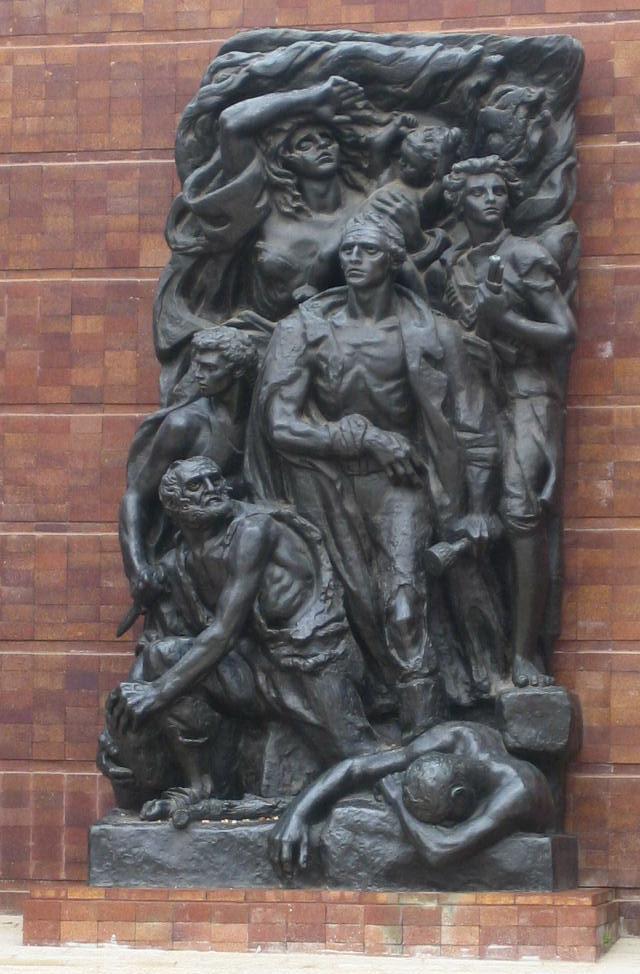
Yad Vashem


Today we toured Yad Vashem and Mt. Herzl in West Jerusalem.  It was, of course, emotionally draining, and also intellectually challenging; our guide Ophir Yarden helped us put together pieces of the narrative in deeper ways.   Yad Vashem literally means "A hand and a name." This refers to memorializing those who have no biological descendants to carry on their name. 

We started out learning how the definition of heroism has changed for Jews over the decades.   Is it heroic to lay down your life rather than give up your religion?  This was considered the honorable choice for Jews during the Spanish Inquisition and other persecution in the middle ages. 


 Is it heroic to give your life to protecting your fellow citizens? Throughout the struggle for Israeli independence, self-sacrifice for the good of the nation was the prevailing definition of heroism for Israelis, whether laying down one’s life in the armed forces or devoting one’s life to the establishment of the state through industry. 


 Is it heroic to fit in and go along with orders to try to save your own life? This questions is a little more complex.  Today we might more easily say, yes, of course it takes courage just to survive, but many Israelis in the 1950s would have judged Holocaust survivors as too passive or compromising compared to the the martyrs of the Warsaw ghetto uprising and other resistance movements. This attitude changed with the Eichmann trial in the early 1960s, when the story of the Holocaust captivated the nation for weeks.  As the story of the atrocities was publicly shared and mourned, it became clearer that mere survival and efforts to maintain the Jewish way of life were very heroic acts.  In addition, the young state of Israel felt heroic for apprehending and bringing justice to one of the enemies of its people. 

 Is it heroic to plant a tree?  Irma Lauscher was a teacher in the Czeckoslovakian ghetto of Terezin.  Despite food shortages and children disappearing every day, she felt compelled to teach the young ones.  In 1943 for Tu bi-Shevat, the holiday of trees, the children planted a tree.  Throughout the Soviet era, Mrs. Lauscher took tourists through the Terezin ghetto and pointed out this tree, lamenting that none of the children who planted it survived.  After her death, her daughter continued the task of educating visitors, and met one of the surviving children.  A seedling from that tree now stands in the gardens at Yad Vashem.  (To read more about Mrs. Lauscher, click here.  The story of the tree is 2/3 down the page.) 

This was my second time at Yad Vashem, and Megan's first time.  It is different to watch my daughter read  and watch survivor's interviews about such harsh historical realities.  I wish she didn't have to confront such terrible things, but if she does, I'm glad I could be there with her.  Below are some of the stories I learned more about this time.  The underlined words contain links if you want to learn more.

I learned this time that the first victims of Nazi brutality were the terminally ill and handicapped in Germany.  Euthansia camps "cleansed" the population until the churches protested enough, and then the personnel were sent to Poland and eventually established the death camps.

In 1939 only China would allow immigrants without a visa.  The ship St. Louis loaded with refugees was rejected by Cuba and the United States, and nearly half who returned to Europe did not survive.


As Jews were herded into ghettos,  many residents felt it was important to document the injustices there.  In the Lodz, a newspaper was secretly published.  In the Kovno, artists such as Esther Lurie were given a reprieve from hard labor to sketch the people and events of the ghetto.


 The  Warsaw ghetto leaders left written records, and the Polish resistance also smuggled in a living witness, Jan (Kozielewski) Karski, in 1942.  Karski also snuck into Belzac concentration camp.  He then reported to world leaders what was really happening to the Jews in Europe.  We watched a video of Mr. Karski describing his visit with President Roosevelt.  He said, "Mr. President, I am going to return to Europe and tell the leaders that I met with you.  What message do you have?" "You will tell them," said Roosevelt, "that we shall win the war and the enemy will be punished for their crimes. Justice will prevail." 


 In the Sonderkommando rebellion of 1944, women inmates in Auschwitz, like Roza Robota, smuggled tiny bits of explosives from the ammunition plant and passed it along to the resistance movement until they had enough to make homemade grenades.  Fighting with primitive weapons, the sonderkommando were able to partly destroy a crematorium before the rebellion was subdued. 

 Adelaide Hautval was a protestant French psyciatrist arrested for trying to cross a border to attend the funeral of her mother.  Denouncing the way the Jewish prisoners were being treated, she was given the armband "Amie des Juifs," "Friend of the Jews," and sent to share their fate.  At Birkenau, she treated inmates for typhus as best as she could, avoided reporting the ill thereby sparing them immediate death, and supported her fellow inmates, saying, ”we are under sentence of death. Let us behave like human beings as long as we are alive.” She was given a reprieve from prison to work in the medical clinic in Auschwitz and initially was working on cancer research.  But when she quickly realized the operations were inhumane, she refused to participate and was sent back to Birkenau.  After the war, Mrs. Hautval testified against doctors who had performed inhumane medical experiments in Auschwitz.  To those who said it was impossible to act otherwise under the circumstances, she held up her own example of refusing to participate in the cruelty.


 The museum was extremely informative and moving.  A tree-lined walkway outside the museum contains plaques dedicated to the memory of non-Jews who put themselves in harms way by trying to save Jewish lives.  These men and women are celebrated as the Righteous Among the Nations , a reminder that there were many notable exceptions to the brutality and indifference. 

As two schoolchildren left Yad Vashem years ago, their teacher heard one say, "We gotta make sure nobody ever does this to us again!"  After a pause, the other boy said, "Yeah, but we gotta make sure nobody ever does this to ANYBODY ever again."  The lesson of Yad Vashem is both particular to Jewish antisemitism, and universal to any form of cruelty against humanity. 

Martin Niemoller's famous quote has many incarnations (click here for a scholarly treatise on the quotation).  Here is one version:

First they came for the communists, and I did not speak out--
    because I was not a communist;
Then they came for the socialists, and I did not speak out--
    because I was not a socialist;
Then they came for the trade unionists, and I did not speak out--
    because I was not a trade unionist;
Then they came for the Jews, and I did not speak out--
    because I was not a Jew;
Then they came for me--
    and there was no one left to speak out for me.

Friday, June 24, 2011

Egypt: Temples and Tombs

Here's more about Egypt- We traveled there in January 2011, and I wrote but forgot to publish this post, so hopefully better late than never!

The Pyramids of Egypt were really amazing.  To walk around them, to enter and touch them--even though they are just empty and stripped of their treasures-- trying to imagine the manpower and skill required to make something so immense, something so long lasting, was like coming face to face with something impossible, yet real and tangible.  Tombs of the workers have been found, which leads many to think that the labor force was not made of slaves, but devoted worshippers and skilled craftsmen who sought to honor the gods and the pharaohs who represented gods on earth. 

The sloping sides of the pyramids were intended to represent the sun's rays, a symbolic connection between the divine and the earthly.  In the temples of later dynasties we saw many other symbols of that connection between divinity and humanity. But first another look at Sakkara, near the Step Pyramid of Djoser (3rd dynasty).

   This is a hypostyle hall at Sakkara, like walking through a stately, shady forest.  The columns here represent bundles of logs or papyrus reeds, a common but short-lived building material here mimicked in long-lasting stone.  Considering his many innovations, it is interesting that Imhotep would design his new stone columns and ceilings to look like the conventional building materials of his day.

 
Light filters in from openings high above, which represents heaven.  The ceiling also looks like bundles of reeds.  This is considered the first hypostyle hall even though it only has 40 columns, the majority of which are attached to the walls behind, leaving niches where the gods of all 24 provinces of Egypt would once have been represented.


A great plaza stretched between the colonnaded entrance and the step pyramid, where every 25-30 years the king would have to prove his worthiness to continue to reign by racing a bull, then sacrificing the bull at an altar.

Here in Sakkara I saw my first ancient hieroglyphs into the limestone walls.  I was about to take my fourth photo of the carvings, but Frank reminded me that we would be seeing plenty more of them. 


Sorry for the shadowy photo, but this is a hunting scene from inside the tomb of Ti at Sakkara.  Many daily life scenes lined the walls.  The red and blue colors are still visible, giving us an idea of how beautiful the tomb paintings were when they were complete. 


Valley of the Kings  

Because later pharaohs didn't have the resources to build and maintain pyramids, and because pyramids were consistently vandalized, the Valley of the Kings became a popular burial place.  Its location was so secret that legend says craftsmen were conveyed to the valley while blindfolded.  Smaller shafts and tombs were easier to build, and decoration within tombs became more elaborate. 

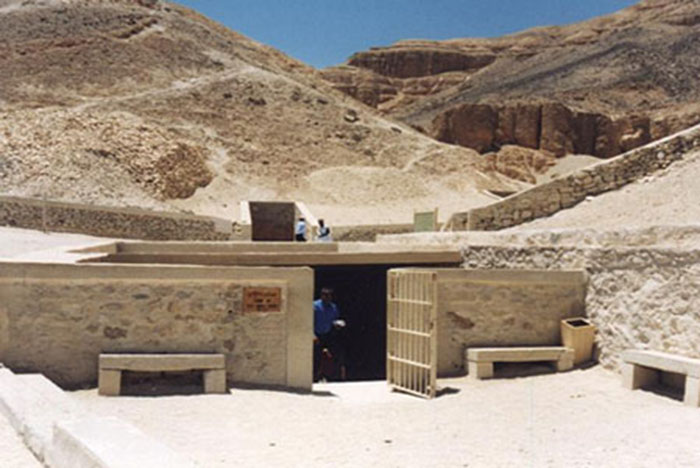
This valley within a mountain range contains many famous tombs from the 18th dynasty onward which are open on a rotating basis to limit exposure to the elements.  Unfortunately, photography is not allowed. 


We visited King Tutankaman's tomb and saw the the massive outer sarcophogas as well as the actual mummy.  (It was wrinkly and black). 

The sarcophagus was closed when we visited, so this photo is from the internet.  Notice the huge larger-than-life painting.  The figure in white on the right is the deceased pharaoh, and his mouth is about to be opened by his high priest Ai, so that he would be able to speak in the afterlife. 


This is the temple of Hatshepsut, the female pharaoh, located on the other side of the mountain range from the valley of the kings.

As tombs got smaller and more centralized, temples got bigger and more centralized.  They celebrated nature, depicted dieties giving strength and wisdom to the pharaoh, celebrated the pharaoh's military victories, and even thanked donors who brought offerings.  


The hypostyle hall of Luxor Temple is the ultimate in this architectural form, with carvings of animals, birds, and plants lining its 134 columns. 


Once again the ceiling represents heaven, the floor is earth, and the columns represent the creations on the earth. 

There is always more to say and more to see, but I have to wrap up this post.  These massive structures and mysterious symbols still have the ability to make humans feel dwarfed and insignificant, to inspire respect for the ancient craftsmen and the civilization that shaped these monuments. 


Here are some beautiful pictures from Mt Sinai


nanananananananana BANANA MAN!!!!!!!!!!!! (Thanks, Carrie!)

Carrie's pics


I, Carrie, the one who is writing this post, has had a cellphone for the last 10 months for the first time in my 13 1/2 years of living. Since I do not have a camera, and my phone does, I have been taking pictures for the last 8 months (we switched phones 2 months into the year) and have filled up all my memory (the phones, not mine) and have been forced to load them all onto the computer. And since I cannot recognize all of them to put them in various categories, I will just attach them all to this post and try my best to tag them.
thank you.


 Tashara got her face painted at the halloween party by Rachel Reese, and wore it to school the next day

Happy

Happier

HAPPIEST!!!!!!!!
(crinkle crinkle)


Tashara- always happy (who could forget that smile??)

CHEEEEEEEEEZE!!!!!!!

Goodbye Ashley Barney

Goodbye Tara


Goodbye Jaqueline Schnieber


Goodbye Amy Carston
GOODVYE STUDENTS WELL MISS YOU!!!!!!!(cry cry sniffsniff)

At the Christmas Eve Parade in bethlehem, I tried to be tasharas paparazzi person


Okok the two boys in the backround were COMPLETELY accidental, I promise


We get beautiful roses on out balcany!!


 This is me trying to get a pic of this super cool holagram of the old temple at David's Citadel that i was too short to see all the way


models of jerusalem


Beautiful mosaics!!!!

I took these pics before I found out flash photography was not allowed. oops!


My bulliton board

Whitney Gasser- my bestest friend!!!!!!!!

Sunset


The "pencil sharpener"

our pet snail


Sabrina sleeping


GALILEE

The sea of Galilee- Beautiful!!!!!!!!


Me and tashara's sand butterfly


someone built the Navoo Temple


 Fish...


Tashara and my sand turtle- made at night

the opposite shore of the sea of galilee


Me trying to take a pic of the birds in the nest under our porch roof


thats not all!