
Today we toured Yad Vashem and Mt. Herzl in West Jerusalem. It was, of course, emotionally draining, and also intellectually challenging; our guide Ophir Yarden helped us put together pieces of the narrative in deeper ways. Yad Vashem literally means "A hand and a name." This refers to memorializing those who have no biological descendants to carry on their name.
We started out learning how the definition of heroism has changed for Jews over the decades. Is it heroic to lay down your life rather than give up your religion? This was considered the honorable choice for Jews during the Spanish Inquisition and other persecution in the middle ages.
Is it heroic to give your life to protecting your fellow citizens? Throughout the struggle for Israeli independence, self-sacrifice for the good of the nation was the prevailing definition of heroism for Israelis, whether laying down one’s life in the armed forces or devoting one’s life to the establishment of the state through industry.

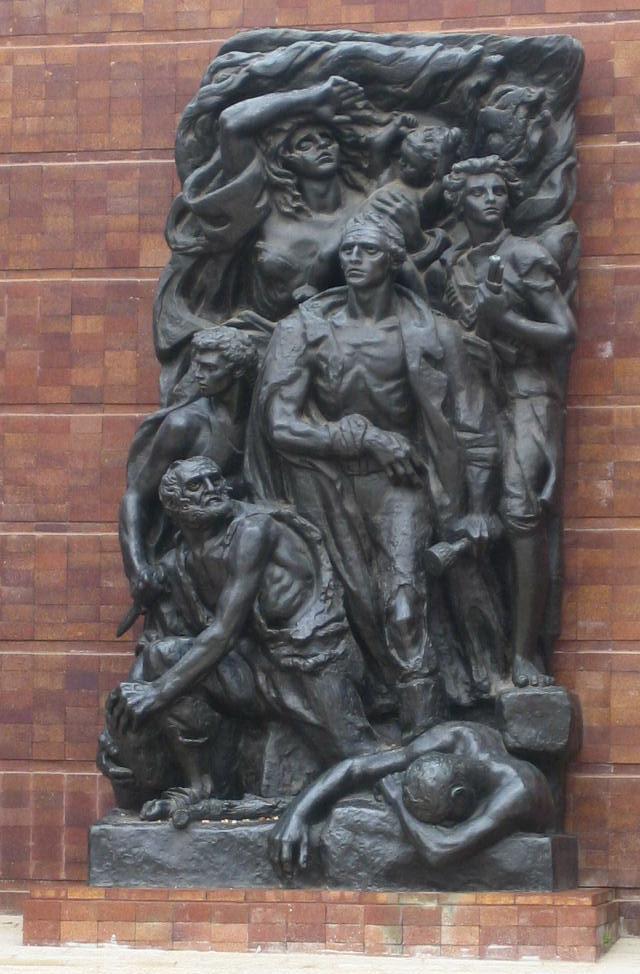
Is it heroic to fit in and go along with orders to try to save your own life? This questions is a little more complex. Today we might more easily say, yes, of course it takes courage just to survive, but many Israelis in the 1950s would have judged Holocaust survivors as too passive or compromising compared to the the martyrs of the Warsaw ghetto uprising and other resistance movements. This attitude changed with the Eichmann trial in the early 1960s, when the story of the Holocaust captivated the nation for weeks. As the story of the atrocities was publicly shared and mourned, it became clearer that mere survival and efforts to maintain the Jewish way of life were very heroic acts. In addition, the young state of Israel felt heroic for apprehending and bringing justice to one of the enemies of its people.

Is it heroic to plant a tree? Irma Lauscher was a teacher in the Czeckoslovakian ghetto of Terezin. Despite food shortages and children disappearing every day, she felt compelled to teach the young ones. In 1943 for Tu bi-Shevat, the holiday of trees, the children planted a tree. Throughout the Soviet era, Mrs. Lauscher took tourists through the Terezin ghetto and pointed out this tree, lamenting that none of the children who planted it survived. After her death, her daughter continued the task of educating visitors, and met one of the surviving children. A seedling from that tree now stands in the gardens at Yad Vashem. (To read more about Mrs. Lauscher, click here. The story of the tree is 2/3 down the page.)
This was my second time at Yad Vashem, and Megan's first time. It is different to watch my daughter read and watch survivor's interviews about such harsh historical realities. I wish she didn't have to confront such terrible things, but if she does, I'm glad I could be there with her. Below are some of the stories I learned more about this time. The underlined words contain links if you want to learn more.
I learned this time that the first victims of Nazi brutality were the terminally ill and handicapped in Germany. Euthansia camps "cleansed" the population until the churches protested enough, and then the personnel were sent to Poland and eventually established the death camps.
In 1939 only China would allow immigrants without a visa. The ship St. Louis loaded with refugees was rejected by Cuba and the United States, and nearly half who returned to Europe did not survive.

As Jews were herded into ghettos, many residents felt it was important to document the injustices there. In the Lodz, a newspaper was secretly published. In the Kovno, artists such as Esther Lurie were given a reprieve from hard labor to sketch the people and events of the ghetto.


As two schoolchildren left Yad Vashem years ago, their teacher heard one say, "We gotta make sure nobody ever does this to us again!" After a pause, the other boy said, "Yeah, but we gotta make sure nobody ever does this to ANYBODY ever again." The lesson of Yad Vashem is both particular to Jewish antisemitism, and universal to any form of cruelty against humanity.
Martin Niemoller's famous quote has many incarnations (click here for a scholarly treatise on the quotation). Here is one version:
First they came for the communists, and I did not speak out--
because I was not a communist;
Then they came for the socialists, and I did not speak out--
because I was not a socialist;
Then they came for the trade unionists, and I did not speak out--
because I was not a trade unionist;
Then they came for the Jews, and I did not speak out--
because I was not a Jew;
Then they came for me--
and there was no one left to speak out for me.


No comments:
Post a Comment
We invite your comments, but if you want to contact us directly and don't know our email address, contact us at jerusalemjudds@gmail.com.