
The Dome of the Rock covers the peak of Mount Moriah, where Abraham offered up his beloved son. This story and this site are revered by Jews, Christians, and Muslims. Here sat the Temples of Solomon, Zerubbabel, and Herod. We passed many Muslims praying, fountains for ritual washing, graceful arched entryways, tall trees and artistic geometric designs.


Following the commandment to not worship graven images, this shrine is decorated with passages from the Quran in Arabic calligraphy.

This is a look at the back entrance to the Golden Gates, which is permanently sealed. You can get an idea of how large these gates are.


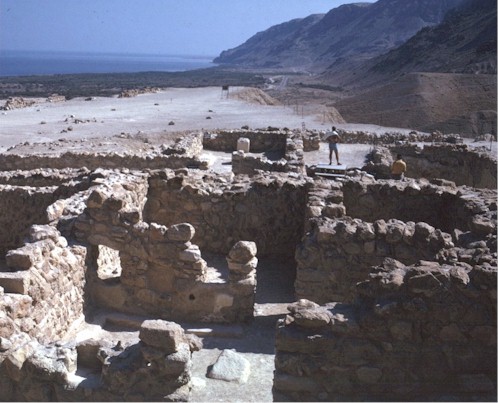


Among the ruins can be found a large dining hall, a scriptorium, and several mikvot, or ritual baths for immersion. These stairs led down to a font of water, and although the right side of the stairway has deteriorated, you can see a raised divider that would have symbolically separated those who were descending in a ritually impure state from those ascending in a pure state.

Off to the left of Carrie you can see the famous Cave 4.

Qumran seemed to be a place of spiritual refuge, not military refuge. When the Romans came along, not even the remote, hilly location and water storage could protect Qumran. Masada, on the other hand, was the paragon of fortresses.

To a rugged, inaccessible mountaintop (we rode a cable car), Herod added walls, palaces, barrel vaulted storage rooms, and Roman-style bath houses. He channeled the mountain run-off to flow into deep cisterns, from which water would be carried up by donkeys.


After its construction, Jewish Zealots took over Masada and turned the Roman-style fortification against the Romans. During the Zealot's occupation, a synagogue and mikvot were added.

We walked down to Herod's three-tiered palace with its amazing view of the valley. Remnants of the columns and painted stucco hints at the grandeur of these rooms. The rock here is quite crumbly, and modern reinforcements help protect the stairways and cliffs from erosion.


Through a glass window we could see a scribe copying the Torah according to the ancient traditions.


The black line behind us destinguishes between original walls and reconstructed walls.


Our next stop was a canyon extending west from the Dead Sea coastline (1388 ft below sea level) into the cliffs that supported the Judean Hill Country (655 feet above sea level). Shade, waterfalls, and wildlife make this site memorable. Ein Gedi means the spring of the kid, (the goat kind) but we saw herds of ibex instead.

The trail was steep and uneven, but we made it to the waterfall by holding on the the rod of iron.


Our final stop of the day was a dip in the Dead Sea itself. The water level has been dropping for years as the Jordan River has been harnessed for agriculture upstream.

The southern portion of the sea consists of shallow evaporation basins where minerals are harvested (see the parallel lines in the photo above).

The high mineral content (about 30% salt) means that any open cuts will sting, and bathers are warned to keep the water out of eyes and mouth. We got used to the smell, but the taste of even the tiniest drop of water on our lips was very bitter.


Three generations in the Dead Sea: Carrie, Jill, and Grandma Ann Fillmore. This was fun once we got used to the cool temperature. After our Dead Sea experience, we drove home to prepare for Christmas Eve.
An unexpected opportunity opened for us to go to Bethlehem for the Christmas Eve parade and dinner at Odeh Marcous's house. We were thrilled for this opportunity and grateful to the Jerusalem Center administration and branch members who made this possible.

At Manger Square, we explored the shops, and one craftsman showed us how the olivewood ornaments were made.


Emily made a new friend, a Muslim woman who was enjoying the parade with her children. The whole town of Bethlehem seemed to be in Manger square, with head scarves outnumbering Santa hats.


Frank Sr. and Lisa were interviewed by Fox News and asked how they felt celebrating Christmas in Bethlehem. Lisa said Christmas feels more real here because this is where Jesus lived. Frank Sr., Lisa, and Amanda showed up on international television.

The children were given free roses, and locals were friendly.


We didn't have a great view of the parade, but we enjoyed hearing the Christmas carols played by marching bands and bagpipe bands. We even saw marching boy scouts. (Boy scouts from our branch had an overnight last semester with a Palestinian boy scout troop.)

After the parade, we connected with other branch members and had a fun-filled taxi ride to the other side of town near the checkpoint.

We went to Adam Souvenir, where branch member Odeh Marcous sells olivewood souvenirs not far from his home. He was very kind and generous with us and patient with our kids' curious exploration of all the trinkets.


Odeh's wife Sena supports him in hosting LDS meetings in their home and cooked an amazing meal for us of rice, chicken, carrots, potatoes, and onions, with traditional Arab side dishes.


We even had a Samuel the Lamanite (Kaleb Muhlestein) who dodged paper wads. I told Dr. John Jackson that we were going to throw rocks at Samuel, but promised none of them would hit him. Dr. John said, "Good, because I'm ready for bed and I wouldn't want to have to come and stitch him up."
Christmas Morning was the Sabbath, and we opened our stockings before church, but the rest of the presents had to wait until after. There just wasn't time before, and we wanted to savor the gifts, not just tear them open. We skyped with family members for most of the evening.

With time running out for the Grandparents' visit, we went to the Western Wall.

I was intrigued by the pioneer bonnet of this woman named Rose from Hong Kong. It was a gift from a friend, and she likes the way it protects her from the sun. Why didn't I think of bringing my bonnet?


This stone had been overthrown from the pinnacle of the temple, and an inscription (to the left of Frank's mom) connects it with the place of trumpeting. Today in some Jewish areas of the city, I am told, a siren warns the faithful that the Sabbath will begin in a half an hour. Perhaps in ancient times the Shofar or ram's horn trumpet did the same thing from the pinnacle of the temple.

Just one of the massive stones at the base of the Temple Mount.


I didn't take any photos during Hezekiah's tunnel, but it was fun and quite cool, and we emerged into the sunlight at the pool of Siloam. This is a very nice place to talk about spiritual sight and miracles.


Tel Maresha is one of our favorite places, but this time the place was claimed by a photographer and a bunch of fashion models. On the bright side, we didn't get as much of the chalky limestone all over our clothes this time.

Speaking of chalky limestone, the Bell Caves at Beit Guvrin are another fun site. The curving walls magnified our voices as the kids ran around like little goats.


On the first bonus day, the grandparents took a taxi to the Holocaust Museum. The next day, Frank took them to David's Citadel Museum.
.

Later that day, we visited the kid's school en route to the Mahane Yehuda shuk and the pita factory

Then on our very last day, we went to the Herodian. The weather didn't cooperate, but it's hard to complain about a little rain when we live on the edge of a desert during a seven-year drought.


We felt so blessed to have both sets of parentshere for Christmas. Frank took them to the airport late New Year's Eve, and our wonderful visit came to an end. There were detours on the way home, especially in the luggage department, but everyone was safe and sound.

