I'm including just a fraction of the photos from our trip, and I took photos of only a fraction of all I saw! Hopefully I can describe the photos in ways that make sense, but if not, just scroll through and get the general overview. The takeaway message is, if you have the chance to go to Egypt, jump on it! Get a reputable touring company with appropriate security precautions, though. We went with Gabry tours, and they treated us very well. We had a police escort from the hotel to the airport, just as a standard precaution, and we had an armed (plainclothes) security guard on the bus at all times. Okay, that was meant to be reassuring, but I think it has the opposite effect. But really, if you get a chance to go to Egypt when there is not a State Department warning, then you should definitely go.
The night before we left we celebrated Frank's birthday quietly, as requested, with some dessert at home.

Random lizard in the kiddie section of the airport...
Airplane food!
Lisa's first look at the streets of Cairo (Frank and I came in 2011). It is hard to escape the impression of poverty here, but there is plenty of evidence of wealth in the ritzy part of the city, and lots of signs of commece and industry in the suburbs and urban areas.
This is a memorial to Anwar Sadat, who was assassinated after signing a peace treaty with Israel.
Here are the presidential grandstands, just across the street, where the assassination took place.
Cairo's citadel sits atop a hill, a walled area containing two exquisite mosques which we visited later.
First crossing of the Nile!
Our first stop on the first day was Cairo's old city. A massive wall and narrow gate reminded us of Jerusalem's old city. We had to navigate the crowded plaza with care, as there was a movie scene in progress and people were crowding around pointing cell phones at the actors. Pretty soon the locals were pointing cameras at us, taking selfies with the foreigners, especially the blondes. By the way, if you are a young single blonde woman and you have the chance to go to Egypt, consider dyeing you hair or bringing along a very large male friend.

The architecture was stunning, both outside the gate and within the city as well. The sunset made photography difficult, but there was beautiful stonework and woodwork all along our path.

We saw mosques, hospitals, and schools, then spent an hour after sunset in the covered Khan al Khalili Bazaar. It was crazy fun! For someone who hates to say no, it was tortuous to turn down so many assertive shopkeepers. We bought Lisa a name necklace, but "Lisa" wasn't one of the options so she choose Amira, princess.

We stayed at the Fairmont Hotel, which was very ritzy! We had great food on this trip, each buffet with so many choices and excellent service.
On Monday, which happened to be October 31, we drove an hour into the countryside to Memphis.

I think this is a columbarium, a pigeon high-rise.


Onlookers were very friendly. I tried to take a photo of this kid waving to us, but I missed it. Granted, we had the friendliest student I've ever met on our bus, so maybe that's why everyone waved at us!


In Memphis, a colossal statue of Ramses reclines under a 2-story roofed building. Perhaps Moses' encounter with Pharaoh took place in Memphis, which was formerly the capital but still an important administrative center when the capital literally headed south.
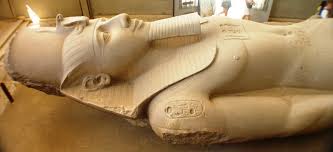
(Photo from Wikipedia, it's better than mine.)
Next we explored the days when the pyramids were a brand new idea, and kings were buried in underground tombs covered by rectangular temples, or mastabas (often made of brick). Here is the entrance to the Sakkara tomb complex, through a fancy temple with dramatic columns.
On the other side of the colonnaded entrance, we could see the pyramids' great grandpa, you could say. Imhotep, architect for Pharaoh Djoser, stacked several mastabas on top of each other to increase the wow factor. This meant the structure had to be stronger, therefore made of limestone, which also increased the wow factor and the cha-ching factor. Behold, the step pyramid.


Next Imhotep got the bright idea that, as long as the structure was ascending up to heaven, why not make the sides diagonal, to represent the sun's rays slanting down, and heighten the religious symbolism? It took a few tries to get the plan right, should he build a step pyramid and then just later fill in the steps to make straight sides? Further south the collapsed pyramid at Meidum disproved that theory. Would steep sides be stronger? On clear days from Sakkara you can see the Bent Pyramid in the distance, where the architect changed angles midway through the pyramid. But pretty soon they got the ideal calculations figured out: bedrock foundation, sides angled at 51.5 degrees, oriented to the four cardinal directions. Later that day we saw the pyramids at Giza, pretty amazing!
Here is a link to an interactive chart showing the relative sizes of different pyramids around the world.
https://en.wikipedia.org/wiki/Pyramid_of_Djoser#/media/File:Comparison_of_pyramids.svg
Close to the step pyramid is the pyramid of Pharaoh Unas, which was unfortunately used as a quarry for other building projects. This kind of "secondary use" is pretty common in the ancient near east. You can see a few smooth facing stones left covering the rectangular blocks. Most pyramids have lost all their facing stones and look blocky up close.
There was an active archaeological site behind Unas' pyramid. Most pyramids had outbuildings and other features nearby, such as funerary temples, pits for the royal boat, and canals.
Inside Unas' pyramid, we found a starry ceiling (my new favorite feature-- think I could get away with this in my living room in Orem?), a sarcophagus, funeral inscriptions on the walls, and an elderly gentleman asking for a tip.
So many amazing places that first morning in Sakkara! Tomb paintings of hunting and fishing scenes (no photography allowed), carved symbols of food and animals which were intended to become real in the afterlife and nourish the soul of the deceased, and a massive underground crypt for mummified bulls in huge granite sarcophagi.
Here is Frank outside the mastaba tomb of Kagemni, a high priest and royal assistant to the Pharaoh.
We ate lunch with the faint outlines of the pyramids visible through the midday haze.
After lunch, we went to Giza. We had a photo-op near one pyramid and went inside another (no photography, lots of vendors...) You can see the blocks ascending up row after row, too high to fathom, too big for a selfie.


Then we drove a few kilometers away to overlook the pyramids so they would actually fit within the lens of a camera.


Then we drove over to the Sphinx side of the pyramid complex for the obligatory awkward pucker photo:

So, let's see if a hat picture is less awkward.

The Pyramids loomed in the distance as the sun set.
We toured a papyrus factory on the way home. The latest artwork features glow in the dark paint, so you have one picture by day and another by night.
We headed back to the hotel for a surprise Halloween dinner party with "costumes" and noisemakers provided by hotel staff.
The hotel staff was so happy to be throwing us a Halloween Party! This was Middle Eastern hospitality on overdrive!
The next day, we headed downtown to see the amazing Cairo Museum. Our bus driver was unfazed by the chaos that seemed so stressful to us non-natives. Below, you can see five lanes of traffic squished in to a space meant for two or three. I heard a tour guide once say, "We pray in lanes, but we don't drive in lanes."
We passed some ancient and modern Christian churches in the city, including Armenian churches.
The amazing Cairo Museum! This was new to both Lisa and I. I didn't get to see it in 2011 because it was too close to the unrest associated with the unfolding revolution. (We were there on January 25.)
Our amazing tour guide, Mohammad, is in the background. He was very knowledgeable about history, archaeology, religion--his own Muslim faith as well as Christianity and Judaism.
Organic sandals! Probably recyclable and compostable, too.
Probably more comfortable than these gold sandals!
In the first few centuries A.D., some mummies had portraits on them, evidence of the Egyptian influence on Greco-Roman expatriate communities


Another Nile crossing!
After the museum, "Happy Birthday" post-its started sprouting spontaneously from Frank's back and appearing on his seat in the bus!
We visited some historic churches commemorating the flight of Mary, Joseph, and baby Jesus into Egypt. This one is St. Sergius. We also saw the Ben Ezra synagogue (no photography allowed). The number of Jews in Egypt is reportedly a dozen or less.
These three-wheeled taxi cars were all over the city.
After lunch we went to the citadel, with its two mosques. The first had an open courtyard, the second was domed like the Blue Mosque or the Hagia Sofia in Turkey.


Off in the hazy distance, we could see the pyramids' faith outline. It didn't really show up in the photos.
We ate dinner on the Nile in a floating restaurant, the Andrea Nile Cruise.
Our tour company's owner, Mr. Dakkak, and his wife joined us for dinner.
There were spectacular views inside and outside on the deck.
Frank was presented with a proper birthday cake, thanks to Mr. Gabry!
...and maybe thanks to a hint from Eran Hayet, our Associate Director.
That evening, we took a late flight from Cairo south to Luxor. The Steigenberger Hotel was our home away from home for 2 nights.
Wednesday we took a boat ride down the Nile to Karnak.
Ram-headed sphinxes guard the way.
Karnak temple Hypostyle Hall:
Obelisk in the middle of Karnak Temple:
Starry ceiling!
We returned by boat for lunch at the hotel.
View from the hotel balcony.
After dinner, we rode a horse-drawn carriage to the Luxor temple.
After Luxor Temple, we went to a late-night bazaar. Once again, there were a lot of desperate shopkeepers and only 80 of us, so we each got a lot of personal attention. I bought a few things. A spice store caught my eye. I asked about the large black round things, and was told they are camel dung. Actually they are a spice that goes in tea.
Another late night and early morning! Thursday, it was off to see the Colossus of Memnon.
Graffiti from the late 1800's: "Lebolo" was an archaeologist and minor character in LDS church history.
We made a quick visit to Hatshepsut's temple in the Valley of the Kings, near the tomb of King Tut. Later pharaohs couldn't afford the expense of a huge pyramid, so they built tombs in this remote mountain range hoping to foil tomb robbers and keep expenses down.
Another amazing hotel lunch!
We sailed in a feluka to a camel ride. You can see the sails of another feluka in the background. Sailing sounds amazing, especially after watching Moana. In reality, it is amazing! Unless there's no wind. In which case you have plenty of time for photos.
We took another late night flight from Luxor north to Cairo, then spent the night in the Fairview hotel, at breakfast, and drove back to the airport. That's because the flights to Israel leave in the morning. It was worth it to have a good night's sleep and two more good meals.
Our last night: a very fancy buffet!
Happy to have the experience, happy to return.


